
Artificial intelligence no longer solely transforms technical professions. It is now profoundly redefining the roles of Project Manager and Product Owner. Task automation, backlog generation, project analysis, augmented management… the use cases are multiplying and tangibly modifying the daily lives of teams. I am Mikael Thomas, Shopify Enterprise Program Director, and I witness this firsthand in the field: the profession is already evolving, and at an unprecedented speed.
A revolution that is no longer measured in years, but in weeks These recent months perfectly illustrate the acceleration of artificial intelligence. New models, falling costs, the arrival of autonomous agents, direct integration into work tools… the ecosystem is now continuously evolving.
This dynamic dictates a new posture: it is no longer enough to learn AI once. The key skill becomes the ability to train continuously and experiment regularly. In this context, Project Managers and Product Owners are particularly exposed. Their profession relies on coordination, structuring, and decision-making—activities directly impacted by AI.
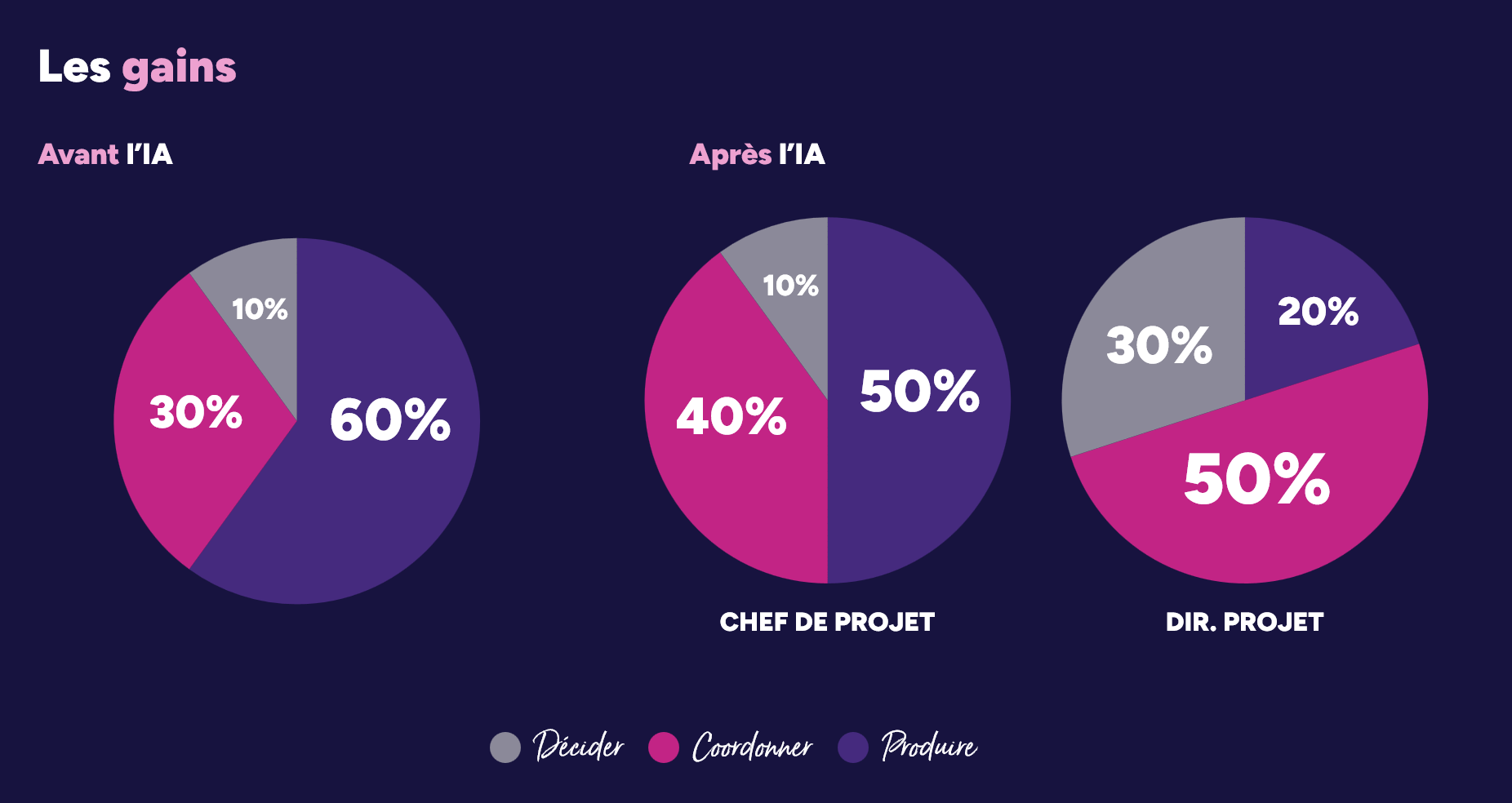
The Project Manager role: a very time-consuming daily life Before the arrival of AI, a large part of a Project Manager’s time was devoted to producing deliverables. Workshops, note-taking, meeting minutes, writing specifications, backlog creation… these tasks are essential but extremely time-consuming. In reality, more time is spent formalizing information than making decisions. When I analyze the workload, I find this reality: about 60% is devoted to production, 30% to coordination, and only 10% to decision-making. Yet, it is precisely this last part that constitutes the main value of the role. This imbalance highlights a paradox: we are recruited to manage and arbitrate, but we spend most of our time producing documents.
What AI already does better than us Today, AI is particularly efficient at structuring and writing tasks. It can synthesize several hours of workshops, structure notes, write user stories, or standardize deliverables in just a few minutes. Unlike a human, it does not get tired, doesn’t forget elements, and can analyze large amounts of information quickly. It thus becomes a true assistant for Project Managers. But some skills remain profoundly human. AI doesn’t perceive the unspoken nuances of a meeting, doesn’t always understand the political stakes of a project, and does not arbitrate in uncertainty. It does not replace the Project Manager, but it transforms their role. The trend is clear: it absorbs repetitive tasks and frees up time for high-value-added activities.
AI DOES NOT REPLACE THE PROJECT MANAGER. IT ELIMINATES THE JUNIOR PART OF THE JOB.
BMAD: when AI becomes a project team
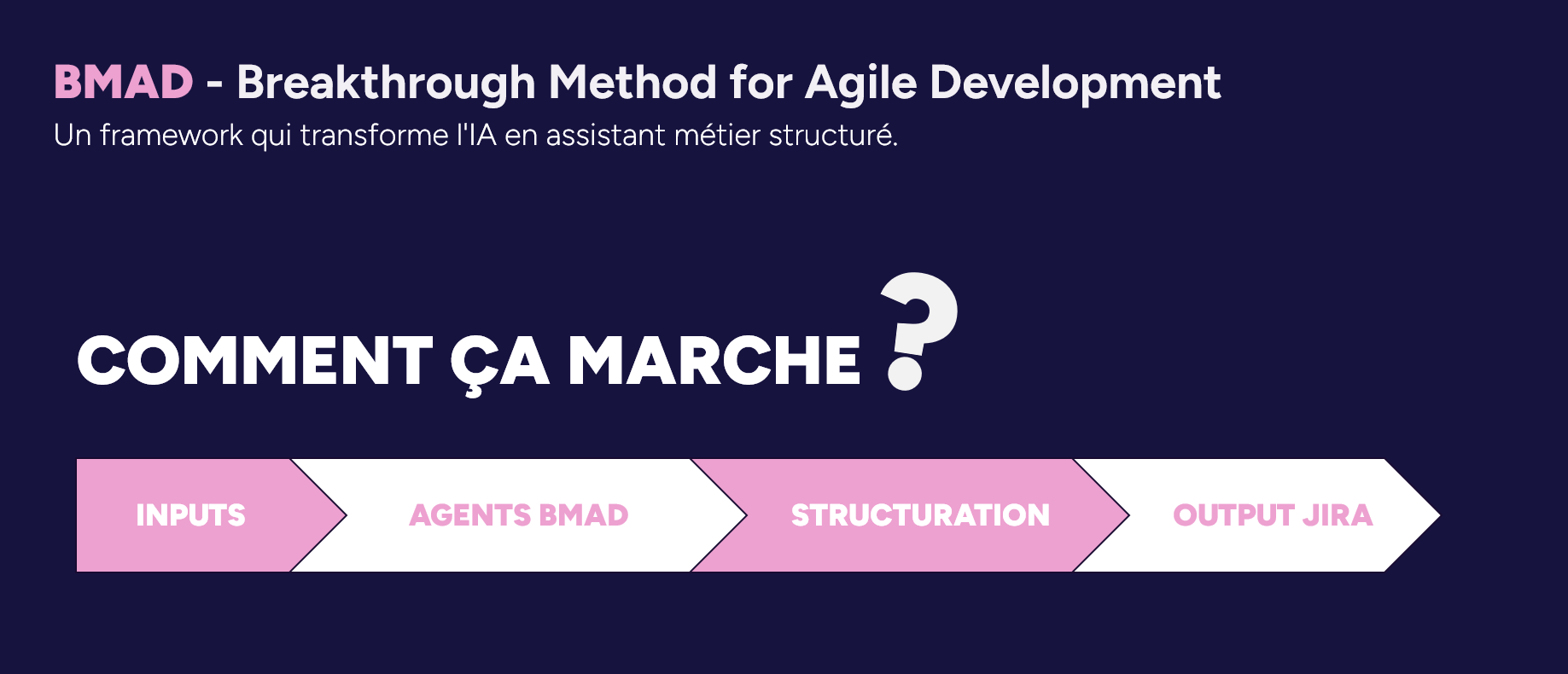
To go further in exploiting these capabilities, I use the BMAD (Breakthrough Method for Agile Development) framework. This method makes it possible to transform artificial intelligence into a true virtual team composed of specialized agents. Each agent plays a specific role: Analyst, Product Manager, Architect, Scrum Master, Developer, or even QA. Together, they collaborate and produce structured deliverables, just like in a classic agile team. The process generally follows four stages: analysis, planning, design, and implementation. At each stage, the AI generates usable artifacts, making it possible to obtain a structured and directly usable backlog. This approach significantly reduces production time while improving the quality of deliverables.
An experiment on a real project
This method was tested on an e-commerce replatforming project to Shopify for Showroomprivé. Three approaches were compared: starting from existing specifications, starting from an existing backlog, or building the backlog from scratch based on workshops. The results are highly instructive. When AI works from rich and contextualized data, the deliverables generated are of very high quality. On the other hand, when the inputs are limited, the results become significantly less relevant. This observation confirms an essential principle: the quality of the AI depends directly on the quality of the data provided.
Benefits that go beyond simple time saving
The most visible benefit remains the reduction in production time. Where creating a backlog used to take several days, a few hours are now enough. But the gains don’t stop there. The consistency of deliverables improves, functional gray areas are reduced, and the quality perceived by clients increases. AI also makes it possible to standardize practices and make teams more scalable. Beyond productivity, it becomes a lever for overall improvement in project quality.
Augmented management for the Program Director
The impact of AI goes beyond just production. Project management is also evolving. On a program comprising more than twenty workstreams, I previously spent one day a week analyzing overall progress. Today, I rely on a centralized source of truth and on AI to analyze the information. It compares data, detects inconsistencies, and highlights weak signals. This makes it possible to anticipate risks more effectively and improve decision-making. Management becomes more proactive and reliable. I can summarize it simply: I no longer manage by instinct. I manage with a co-pilot. 😉
Three essential rules for using AI effectively
Despite its benefits, artificial intelligence requires rigor. First, it is essential to maintain a critical mind regarding the results generated. AI can make mistakes or produce approximate answers. Second, the quality of the inputs is crucial. The more precise and structured the data, the more reliable the results. Finally, it is essential to validate the use of these tools with clients, particularly for reasons of confidentiality and security.
From Project Manager to Decision Architect
The arrival of AI is progressively transforming the role of the Project Manager. Producing deliverables becomes less central, while coordination and decision-making take on a growing role. The Project Manager is thus evolving towards a role of decision architect. Their value relies more on their ability to arbitrate, anticipate, and understand human issues. This transformation is already underway. The Project Manager is not disappearing: they are becoming more strategic. This movement is not theoretical. It is already visible in everyday projects. Artificial intelligence automates a portion of the work and refocuses teams on high-value activities. The real question is no longer whether AI will transform the profession, but how quickly teams will adapt. One thing is certain: those who start experimenting now are already getting a head start.
Mikaël THOMAS E-commerce Project Director | Shopify Enterprise Expert
